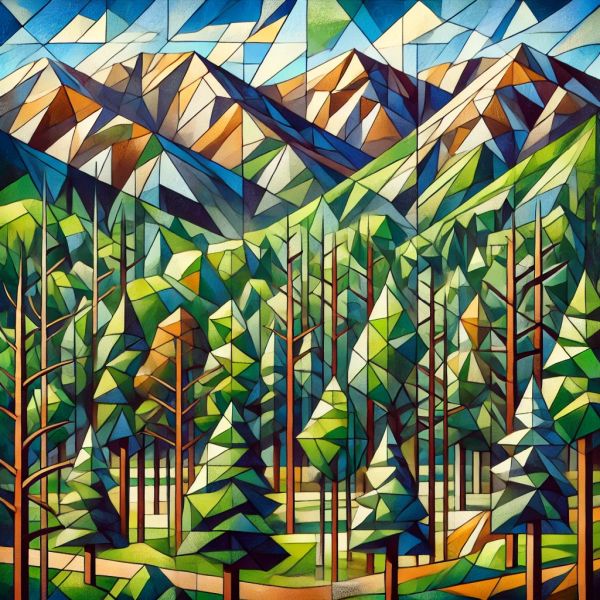
Geometric Mountains and Fragmented Forests: A Cubist Interpretation of Denver
Exploring the mysteries of nature through the lens of cubism, this vibrant artwork reimagines a forest scene set against the backdrop of Denver’s mountainous landscapes. Bold geometric shapes and a mosaic of colors transform familiar natural forms into a dynamic array of fragmented forms, creating an enthralling visual experience. Vivid blues and whites illustrate the towering mountains, conveying their majestic presence, while varying shades of green paint an abstract forest in the foreground. Each leaf and tree trunk is stylized into angular segments, enhancing the sense of depth and perspective. This cubist depiction does not just represent the physicality of Denver’s forests and mountains but invites viewers to experience nature's essence in a novel artistic expression. The artwork encourages a departure from literal interpretations, prompting a deeper engagement with the textures and geometries that compose our natural world. ***About Cubist Art***: Originating in the early 20th century, cubism was pioneered by artists Pablo Picasso and Georges Braque, who deconstructed conventional forms into abstract shapes. This style emphasizes the two-dimensional flatness of the canvas, encouraging a new way of looking at structural elements by reassembling them in abstract forms. Cubism had a profound influence on the trajectory of modern art, inspiring subsequent movements such as futurism and constructivism. The technique challenges viewers' perceptions, encouraging them to engage with art on multiple levels and appreciate the interplay of shapes and colors.
Image ID: 56282
|

 Canvas Prints
 Fine Art Printing
 Framed Prints
 Plaque Mounting
 Fabric Printing
 Metal & Wood Prints
 Plexi Face Mount
 Print & Dry Mounting
 Cityscape Prints
 Greeting Cards
 Classical Art Prints
 AGP Galleries

 Custom Picture Frames
 Canvas Floaters
 Wood Frames
 Metal Frames
 Canvas Transfer
 Custom Stretcher Frames
 Custom cut MatBoards
 Custom Plexi Cuts
 Custom Size Boards
 Pre-Cut Boards
 Framing Hardware
 Mirror Frames
 Upload Your Photos
 Ideas Gallery
 How it works?
  Artwork Scanning
 Laser Engraving & Cut
 Coffee Mug Prints
 Acrylic Blocks
 T-shirt Prints
 Handmade Oil Paintings
 All Products
 Custom Artist Canvas
 Custom Size Wood Panels
 Canvas Stretching Services
 Resources
 DoveTail Guide
 Aluminum Bars
 Wood Panels
 Stretcher Bars
 Easels & Display
 Resin Coatings
 Cork Rolls/Sheets
 Resin On Canvas
 Price Calculator
 Gift Certificates
 Collages on Canvas
 Word Cloud Design
 Photo Mosaics
 Image Effects
 FAQs
FAQs Pro Accounts
 Artist Gallery Program
 Corporate Art
 Contact KeenART
 Turnaround time
 Shipping
 Rush Orders